Samsung announces KRW 2.655 trillion investment plan: reshaping Korea's semiconductor and AI hub
Keywords: Samsung, invest KRW 2.655 trillion, Korea semiconductor, Yongin, Pyeongtaek, AI computing power, AI data center, physical AI, semiconductor supply chain, industrial strategy
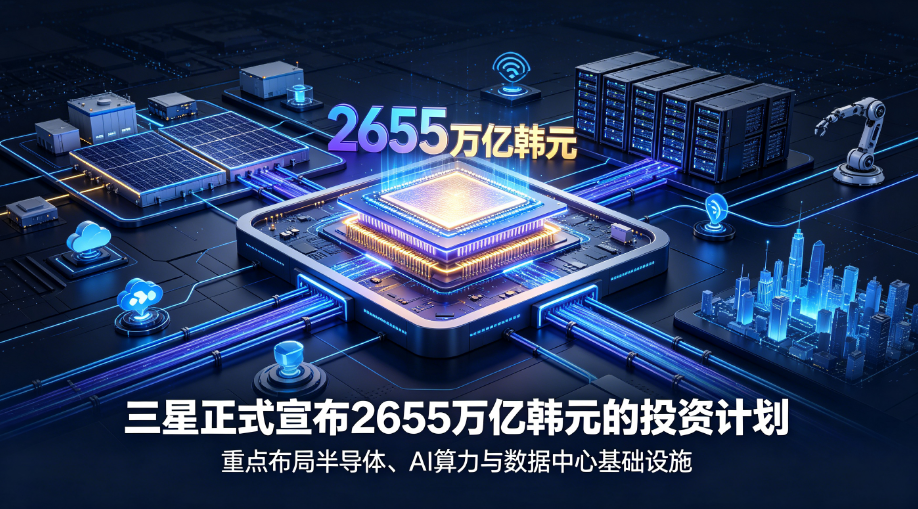
Against a backdrop of intensifying global tech competition, Samsung has officially announced a particularly large investment plan totaling KRW 2.655 trillion (approximately KRW 2,655 trillion). This is not just a symbolic financial move but a strategic statement of the group's long-term ambitions in semiconductors, AI computing infrastructure, and physical AI technology. Of this, KRW 2.03 trillion will be focused on semiconductor clusters in Yongin and Pyeongtaek, two sites seen as key links in Korea's semiconductor ecosystem.
A strategically significant investment move
Samsung's announced massive investment indicates that the group is implementing a structural strategy, not just short-term capacity expansion. Semiconductors remain the core foundation of the digital economy, but notably, Samsung is not only emphasizing traditional chip manufacturing capabilities but also linking investment with AI computing power, AI data centers, and physical AI.
This reflects a clear fact: in the AI era, value no longer resides only in chips themselves but also in the complete infrastructure supporting AI model training, inference, and deployment. Therefore, simultaneously investing in semiconductors and computing infrastructure is Samsung's way of building an ecosystem that can maintain long-term competitiveness globally.
Yongin and Pyeongtaek: new growth poles for the semiconductor industry
Allocating KRW 2.03 trillion to semiconductor clusters in Yongin and Pyeongtaek shows Samsung's strong bet on these two core production hubs.
Pyeongtaek has long been considered one of the most important bases for Samsung Electronics' production of memory chips and advanced chips. Meanwhile, Yongin is gradually becoming a new industrial space where Samsung can expand production capacity and integrate next-generation technologies. The combination of these two locations not only helps Samsung optimize its internal supply chain but also enhances its ability to diversify risks from geopolitical factors, raw material supply, and market demand fluctuations.
From an industrial perspective, this is a systematic development model: Samsung is no longer relying on a single factory or production cluster but building a complementary production network that improves operational efficiency and scalability.
From traditional semiconductors to AI computing infrastructure
A highlight of this plan is Samsung placing AI computing data centers at the core of its investment strategy. As AI models become larger and more complex, demand for computing power, energy, and data storage is growing at an unprecedented rate. AI data centers are not just places to deploy servers; they are the backbone of the AI ecosystem for enterprises and nations.
By engaging more deeply in this field, Samsung can benefit in several ways:
- Increase demand for its own produced memory chips and advanced chips;
- Expand from a component supplier to an infrastructure solutions provider;
- Create new cooperation models between semiconductors, cloud computing, and industrial AI.
In other words, this is a step to transform hardware manufacturing capabilities into platform advantages across the entire AI value chain.
Physical AI: a new highlight in the tech race
In addition to semiconductors and AI computing power, Samsung also emphasizes physical AI, an area of high interest to many countries and tech groups. Physical AI can be understood as the combination of AI with physical systems such as robotics, automation equipment, smart factories, autonomous vehicles, and industrial infrastructure.
When AI is no longer limited to software but enters the real world, the demand for sensors, control chips, memory, high-speed connectivity, and real-time processing systems will grow significantly. This is an area where Samsung has a clear advantage, given its integration capabilities from semiconductors to electronic devices and system solutions.
Strategically, placing physical AI in the same investment category as semiconductors and data centers indicates that Samsung views the tech future through a fusion lens: hardware, data, and operational intelligence are inseparable.
Regional and global competition context
Previously, Korea had indicated that Samsung Group and SK Hynix would announce a large investment plan totaling approximately KRW 2,000 trillion over the next 10 years, focusing on semiconductors, AI computing data centers, and physical AI. Samsung's latest announcement not only reinforces this direction but also suggests that the actual scale may far exceed initial forecasts.
As the US, Japan, Taiwan, and China all accelerate investment in semiconductor supply chains, Korea must rely on capital scale, technological capability, and execution speed to maintain its advantage. Samsung, as a symbol of Korean industry, plays a pillar role in helping Korea maintain a central position in the global semiconductor landscape.
This is not just a competition for market share but also a contest for tech sovereignty. Whoever masters advanced chip manufacturing, data centers, and AI platforms will gain a huge advantage in the digital economy and national security.
Economic impact and industrial policy
Such a large-scale investment plan will inevitably have strong spillover effects on the Korean economy. First, it will drive substantial demand for construction, industrial equipment, semiconductor materials, logistics, and high-skilled talent. Second, it will enhance market confidence in the long-term prospects of Korea's tech industry. Third, it will push the government to improve electricity, water, transportation infrastructure, and talent training systems for high-tech clusters.
However, the huge investment scale also comes with challenges. Such massive projects require close coordination between the company, local governments, and the central government. Without effective alignment, expected benefits may be reduced due to risks in progress, costs, and talent competition.
Conclusion
Samsung's KRW 2.655 trillion investment plan is not just an impressive financial figure but a clear declaration of its development strategy in the new tech era. From semiconductors to AI computing data centers, from Yongin and Pyeongtaek to physical AI, Samsung is reshaping its role: not just a leading chip manufacturer but also an architect of AI infrastructure and digital industry.
In the global tech race, such systemic investments will determine the positions of nations and companies over the next decade. Through this decision, Samsung sends a clear signal: the future of Korean industry will still be built on semiconductors, but with a broader vision where AI and computing infrastructure become new growth drivers.