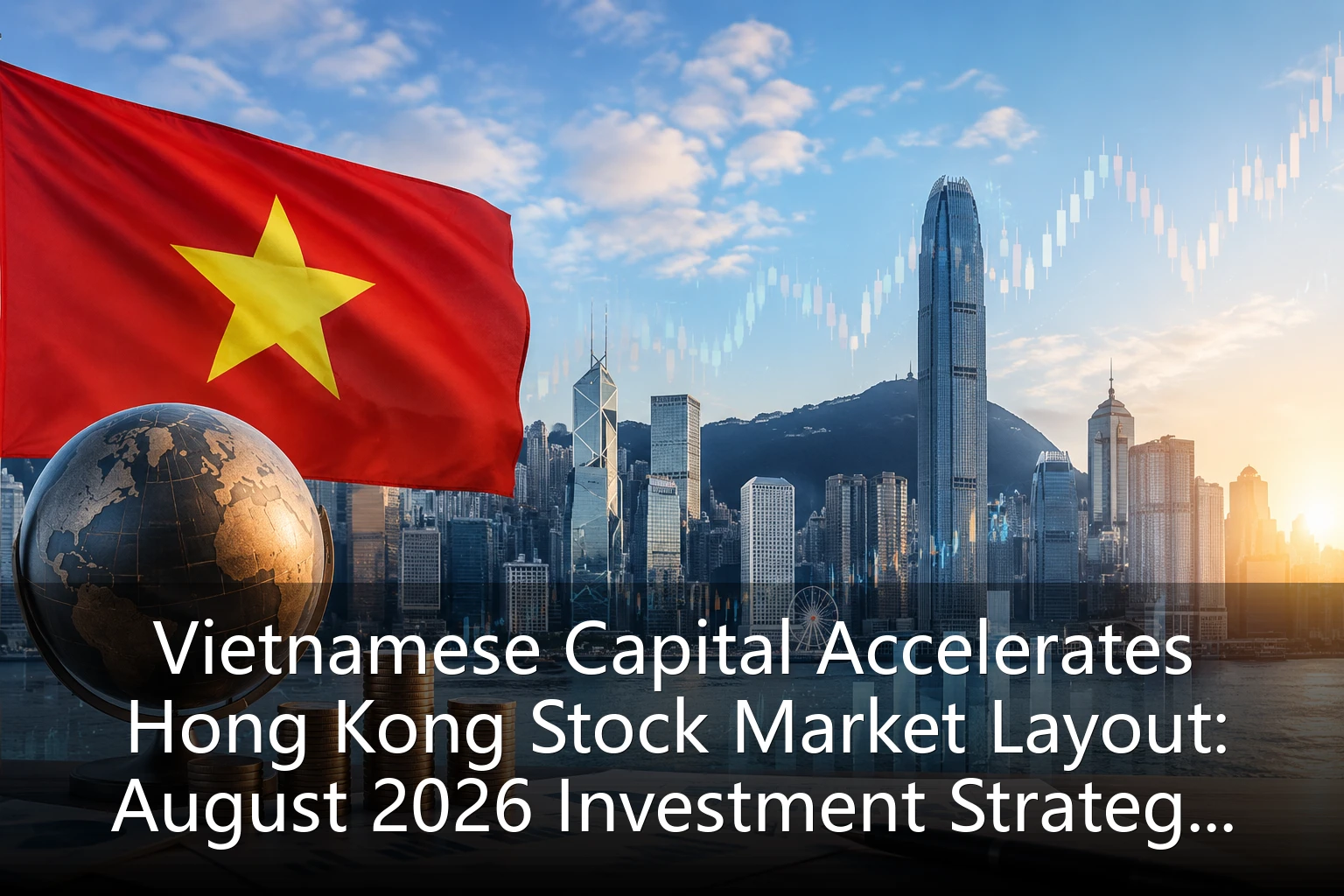
Vietnamese Capital Accelerates Hong Kong Stock Market Layout: August 2026 Investment Strategy Analysis and Market Outlook
\nAgainst the backdrop of continuously evolving global economic landscape, Vietnamese capital is pouring into the Hong Kong stock market at an unprecedented pace, seeking investment opportunities in valuation lows. In early August 2026, as the Hong Kong stock market gradually stabilizes after adjustments, Vietnamese investment funds and private capital are increasing their allocation, a trend that is attracting widespread market attention. This article will analyze the motivations, strategies, and future outlook of Vietnamese capital's layout in Hong Kong stocks from multiple dimensions, providing professional references for investors.
\n\nRecent Performance and Valuation Advantages of the Hong Kong Stock Market
\nIn early August 2026, the Hong Kong stock market showed signs of stabilization after previous adjustments. The Hang Seng Index found support around the 22,500-point mark, with technology and consumer sectors leading the market, demonstrating strong resilience. Compared to other major global markets, Hong Kong valuations remain at relatively historical lows, especially with the average P/E ratio of Chinese Hong Kong stocks significantly lower than similar enterprises in A-shares and US stocks, providing an attractive entry point for long-term investors.
\n\nRecent reform measures introduced by the Hong Kong Stock Exchange have also injected vitality into the market, including a 50% reduction in the minimum tick size, which lowers transaction costs and improves market liquidity. These changes have continuously enhanced the cost-effectiveness of Hong Kong stock investments, attracting more attention from international and regional capital.
\n\nDriving Factors Behind Vietnamese Capital's Allocation to Hong Kong Stocks
\nThe accelerated layout of Vietnamese capital in Hong Kong stocks is supported by multiple factors. First, Vietnam's economy continues to grow steadily, with GDP growth reaching 6.2% in the first half of 2026, and abundant domestic capital accumulation providing a solid foundation for overseas investment. According to data from the State Bank of Vietnam, as of June 2026, Vietnam's foreign exchange reserves have exceeded $120 billion, a historic high, ensuring cross-border capital flows.
\n\nSecond, Vietnamese investors' awareness of the Hong Kong stock market is continuously improving. As Vietnam's financial market openness increases, local investors' understanding of international markets deepens. Hong Kong stocks, as a bridge connecting mainland China and global capital markets, are gradually gaining recognition for their investment value. Many large Vietnamese investment funds have included Hong Kong stocks in their core allocation assets, with the proportion increasing from less than 5% in 2023 to around 12% currently.
\n\nThird, geopolitical factors also prompt Vietnamese capital to seek diversified allocations. Against the backdrop of global trade structure reshaping, Vietnamese enterprises have close economic ties with China. The Hong Kong stock market, as an important financing and listing platform for Chinese enterprises, has naturally become a focus of Vietnamese capital attention.
\n\nInvestment Preferences and Strategies of Vietnamese Fund Capital
\nAnalyzing the allocation strategies of Vietnamese fund capital in the Hong Kong stock market reveals several clear characteristics. In terms of industry distribution, technology and consumer sectors are most favored, which echoes Vietnam's domestic economic structural transformation and consumption upgrade trends. Vietnamese investment funds generally favor leading enterprises with strong brand advantages, stable cash flows, and long-term growth potential.
\n\nIn terms of investment style, Vietnamese capital tends to adopt a strategy combining value and growth investing. On one hand, they focus on blue-chip stocks with reasonable valuations and stable dividends; on the other hand, they actively position themselves in emerging industry leaders with high growth potential, especially in fields like artificial intelligence, new energy, and biotechnology.
\n\nVietnamese investment funds also adopt diversified investment strategies, participating in the Hong Kong stock market through various channels such as Stock Connect, ETFs, and direct investments. Among these, Stock Connect has become an important channel for Vietnamese investors to enter the Hong Kong market. In the first half of 2026, Vietnamese investors accounted for 8.3% of southbound funds, an increase of 2.1 percentage points compared to the same period in 2025.
\n\nMarket Hotspots and Investment Opportunity Analysis
\nThe current Hong Kong stock market presents several clear investment hotspots. First is the technology sector, particularly artificial intelligence-related enterprises, which have shown outstanding performance. With the accelerated iteration of global AI technology, AI concept stocks in Hong Kong have performed strongly recently, with some leading companies' stock prices rising against the market trend, attracting attention from long-term Vietnamese capital.
\n\nSecond is the new energy sector, benefiting from the global carbon neutrality trend and policy support, photovoltaic and wind power enterprises in Hong Kong are facing development opportunities. As a dual perspective in both new energy consumption and production, Vietnam shows particular enthusiasm for investments in this sector.
\n\nThird is high-dividend value stocks. Against the backdrop of increasing market volatility, stable dividend income has become an important factor attracting investors. Vietnamese capital particularly favors blue-chip enterprises with continuous dividend payment capabilities and stable cash flows, such as leading enterprises in the financial, energy, and utility sectors.
\n\nRisk Factors and Response Strategies
\nDespite numerous investment opportunities in the Hong Kong stock market, Vietnamese investors should remain vigilant about potential risks. First, geopolitical factors may bring uncertainties, especially the impact of changes in China-US relations on Chinese Hong Kong stocks. Second, the slowdown in global economic growth may put pressure on corporate profits, especially for export-oriented enterprises. Third, the Hong Kong stock market has high volatility, and short-term adjustment risks cannot be ignored.
\n\nTo address these risks, Vietnamese investors can adopt the following strategies: first, adhere to a long-term investment philosophy and avoid the impact of short-term market fluctuations; second, strengthen fundamental research and select high-quality enterprises with core competitiveness; third, reasonably control position sizes and avoid over-concentrated investments; fourth, fully utilize derivative tools for risk management, such as options and futures.
\n\nExpert Views and Future Outlook
\nIndustry experts generally believe that the trend of Vietnamese capital's layout in Hong Kong stocks will continue to deepen. Nguyen Van Cuong, Chairman of the Vietnam Investment Fund Association, stated: "As Vietnam's economic strength grows and its financial market opens, Vietnamese investors' demand for international asset allocation will continuously increase. The Hong Kong stock market, as an important financial center in Asia, will continue to attract long-term attention from Vietnamese capital."
\n\nLooking ahead, as Vietnam's economic structure continues to optimize and financial openness increases, the proportion of Vietnamese capital in global asset allocation will further increase. Especially under the "Belt and Road" initiative and RCEP framework, Vietnam's economic and trade ties with China will become closer, providing favorable conditions for Vietnamese investors to seize opportunities in the Hong Kong stock market.
\n\nFurthermore, with the rapid development of Vietnam's digital economy, the demand for international capital from technology enterprises is increasing. As an important platform for technology enterprise financing, the Hong Kong stock market will attract more participation from relevant Vietnamese enterprises and capital. It is expected that by 2027, the scale of Vietnamese capital allocation in the Hong Kong stock market could reach more than 1.5 times the current level.
\n\nInvestment Recommendations and Operation Guidelines
\nFor Vietnamese investors interested in participating in Hong Kong stock investments, the following recommendations are worth noting: first, fully understand the rules and trading mechanisms of the Hong Kong stock market and make adequate preparations; second, choose investment products and strategies suitable for one's own risk preferences; third, pay attention to macroeconomic and policy changes and adjust investment portfolios in a timely manner; fourth, leverage the experience of professional investment advisors or fund management institutions to improve investment efficiency.
\n\nIn terms of specific operations, investors can participate in Hong Kong stock investments through the Stock Connect channel, selecting high-quality targets with good liquidity and reasonable valuations; they can also invest in Hong Kong-themed funds in Vietnam to indirectly share in the growth dividends of the Hong Kong market; for professional investors, they can consider constructing diversified international asset allocation portfolios including Hong Kong stocks to balance risk and return.
\n\nOverall, in the current global economic landscape, the Hong Kong stock market provides rare investment opportunities for Vietnamese capital. Through rational analysis and scientific allocation, Vietnamese investors are expected to achieve stable returns in the Hong Kong stock market and realize asset preservation and appreciation. As Vietnam's economic strength continues to enhance and its international influence grows, the voice and influence of Vietnamese capital in global financial markets will also continuously increase.