Trillions in Lockup Share Unlock Loom: Can HK Stocks Survive the "Stress Test" After IPO Boom?
Keywords
HK stock lockup expiry, IPO boom, restricted shares, market liquidity, Hang Seng Index, southbound funds
Introduction
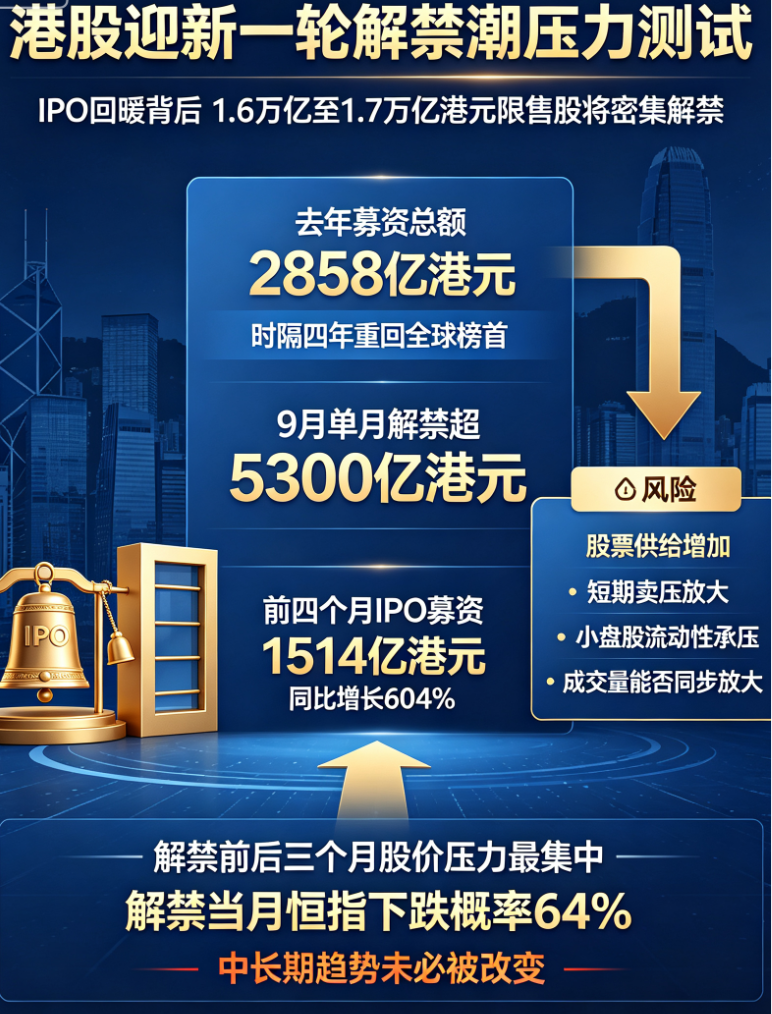
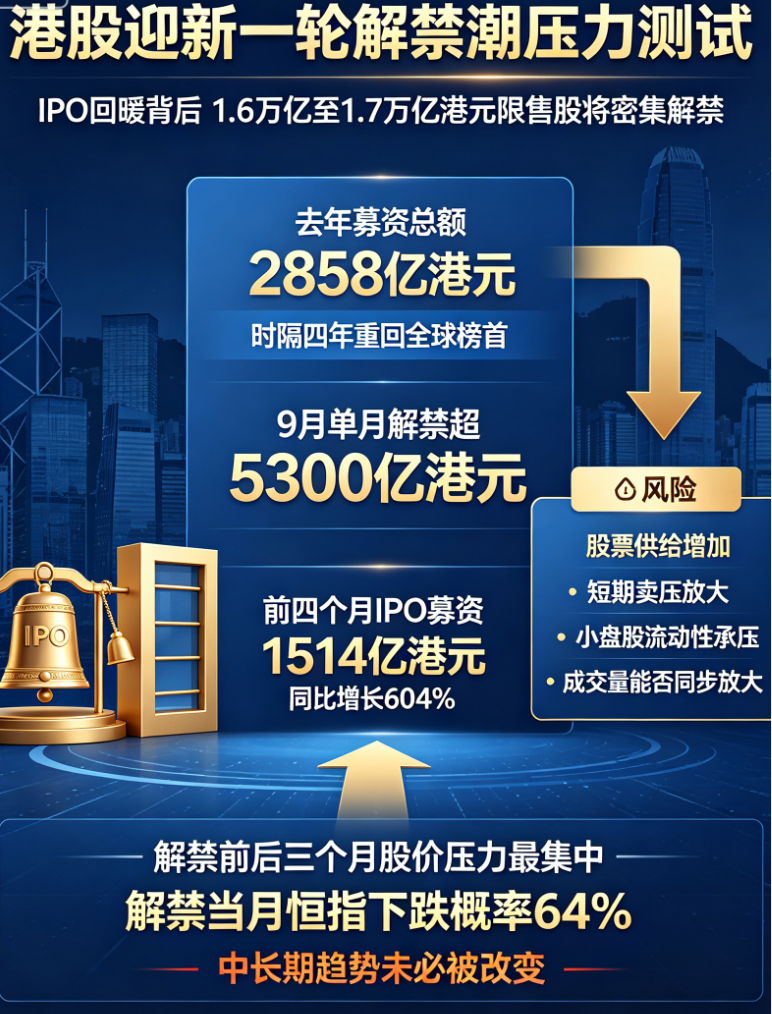
In 2025, Hong Kong's capital market returned to the global top with HK$285.8 billion in fundraising, and 119 companies listed one after another, a bustling market. However, every IPO coin has a flip side: the countdown to lockup share unlocking. Entering 2026, as the IPO frenzy continues with average daily turnover reaching HK$271.1 billion, a more severe test is approaching: within this year, about HK$1.6 to HK$1.7 trillion in lockup shares will be intensively unlocked, with September alone seeing over HK$530 billion "opening the floodgates." Combined with the financing needs of over 400 companies queuing for listings, will the Hong Kong stock market face a sharp sell-off under the "dual squeeze" on funds? This is a "stress test" destined to be written into financial history.
I. Source of the Unlock Wave: The "Gift" and Cost of 2025 IPOs
The record IPO feast in 2025 is the most direct "cause" of today's unlock wave. 119 new stocks concentrated their listings, with fundraising topping the global list. The lockup periods set at issuance were mostly 6 to 12 months, meaning a large number of shares will mature within 2026. According to the typical lockup schedule for Hong Kong stocks, the unlock peak for companies listed in Q4 2025 will concentrate in Q2 and Q3 2026, while the HK$530 billion concentrated unlock in September corresponds to large projects listed around September that year.
Worryingly, the Hong Kong stock IPO heat has not diminished but intensified in 2026. HKEX data shows that average daily turnover in the first four months reached HK$271.1 billion, with 49 companies newly listed, raising HK$151.4 billion in IPO proceeds, a 604% surge year-on-year. As of mid-May, over 400 listing applications were pending review. This means that when the unlock wave hits in Q2 and Q3, market funds must not only absorb massive unlocked shares but also support the financing needs of hundreds of new stocks. This "dual supply-demand growth" scenario is extremely rare in Hong Kong stock history.
II. Impact Path of Unlocking: Short-Term Volatility and Systemic Risk
Does unlocking necessarily lead to a crash? Wen Tianna, CEO of Boduo Capital International, pointed out that a sudden increase in stock supply will amplify short-term selling pressure, especially for small-cap stocks with weaker liquidity. "If market trading volume cannot expand simultaneously, some stocks may experience sustained corrections; but if southbound funds maintain net inflows and quality companies perform steadily, systemic shocks are relatively controllable."
Historical data provides more precise references. SPDB International's statistics on 766 Hong Kong-listed new stocks with regular lockup periods from 2018 to 2025 reveal that the three months before and after lockup share unlocking are the most concentrated period for stock price pressure, with about 58% of sample companies underperforming the Hang Seng Index. Further observing the relationship between monthly unlock peaks (unlock market value exceeding HK$50 billion) and HSI performance: in 11 samples, the HSI fell an average of 0.6% in the unlock month, with a decline probability of up to 64%, significantly higher than 36% in the previous month and 45% in the following month. This indicates that unlock peaks indeed increase short-term volatility and downside risk, but generally cannot change the medium- to long-term trend — especially when market fundamentals are healthy and funding channels are smooth.
The chart shows that the unlock market value in September 2026 (bar chart peak) far exceeds most historical months, and the HSI performance that month (line chart low) is often negatively correlated with unlock pressure. However, after the unlock peak, the market can usually gradually recover.
III. "Two-Front Battle" of Funds: Game Between Unlock Absorption and New Stock Fundraising
The core contradiction of the current market is: can the selling pressure from unlocked shares and the financing demand from new stocks simultaneously erupt, and can the funding side withstand it?
On one hand, the shareholder structure of unlocked shares varies greatly. For cornerstone investors and strategic shareholders, whether to reduce holdings after unlocking depends on their cost base, return on investment, and judgment of the company's prospects. If the stock price is high, the incentive to cash out is strong; if the price has corrected, some institutions may choose to hold. On the other hand, over 400 newly listed stocks waiting to go public will be densely listed in the coming months. Based on the average monthly fundraising scale of HK$37.8 billion in the first four months of 2026, full-year IPO fundraising could exceed HK$450 billion, which itself will drain a large amount of secondary market funds.
However, potential buffer factors cannot be ignored. First, southbound funds continue to flow in net through Stock Connect, with daily average purchases exceeding HK$15 billion in the first four months of 2026, becoming an important "ballast" for Hong Kong stock liquidity. Second, the Hang Seng Index components have a high proportion of high-dividend stocks such as financials and energy, which are attractive in a declining interest rate cycle, potentially attracting long-term funds to buy on dips. Finally, expectations of economic recovery in mainland China and the global capital allocation shift eastward may provide structural support for Hong Kong stocks.
IV. Historical Lessons: The "Not Scary" and "Must Guard Against" Aspects of Unlock Shocks
Reviewing the Hong Kong stock unlock peak periods in 2015, 2018, and 2021, most markets resumed their uptrend after phased fluctuations. However, the special feature this time lies in "magnitude" and "speed": the HK$1.7 trillion unlock market value is equivalent to 6 times the full-year IPO fundraising in 2025, and the HK$530 billion unlock volume in September alone exceeds the average daily turnover for most months in 2025. If simultaneous factors such as concentrated new stock listings and global liquidity tightening occur, the risk of local price crashes cannot be ignored.
Investors need to watch several key signals: first, whether major unlocking stocks have commitments from major shareholders not to reduce holdings or extend lockup periods to stabilize expectations; second, whether HKEX launches liquidity facilitation tools such as block trading and market maker mechanisms; third, whether the Hang Seng Index can maintain a P/E ratio above 20 times during the dense unlock period. From a defensive perspective, blue-chip stocks with low valuations, high dividends, and ample liquidity have more prominent safe-haven value, while small-cap unlocking stocks require extra caution.
Conclusion
The Hong Kong stock unlock wave in 2026 is essentially a "sequel" to the IPO boom of 2025 and a natural pressure release after market expansion. In the short term, the unlock peak will increase market volatility and correction probability, especially testing sectors with fragile liquidity; but in the long run, as long as the fundamentals of listed companies do not deteriorate, southbound funds are not interrupted, and the macroeconomy does not have a hard landing, Hong Kong stocks can still return to equilibrium after absorbing supply shocks. For investors, instead of fearing unlocking itself, it is better to closely monitor fund game signals and look for mispricing opportunities amid volatility. The outcome of this "stress test" will determine whether the Hong Kong capital market can truly consolidate its position as a global financing center in the future.