As market interest in low-cost energy storage technology grows, sodium-ion batteries (SIB) are gradually moving beyond early pilot stages, and sodium salt as their core raw material has become a market focus.
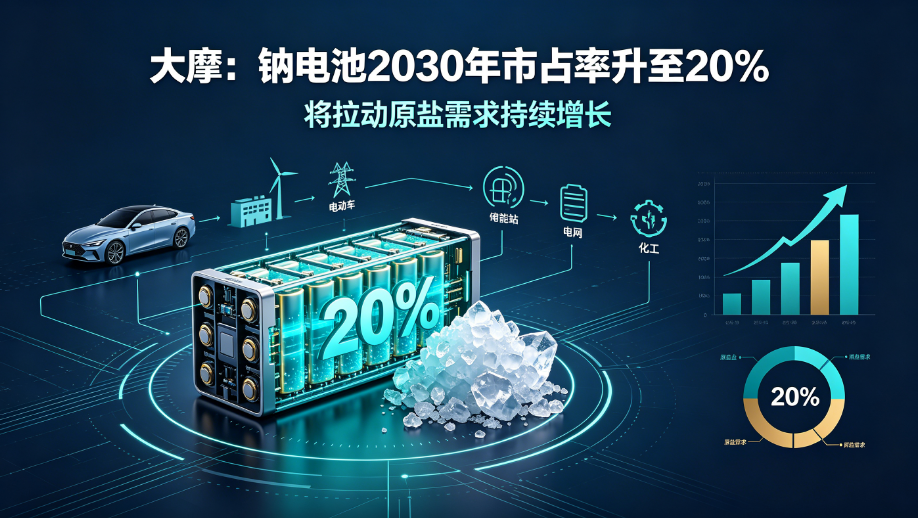
Media reports indicate that Morgan Stanley analyst Jack Lu and his team forecast that sodium-ion batteries' global battery installed capacity market share will rise sharply: about 2% in 2027, 20% in 2030, and further to 37% in 2035.
Jack Lu stated in the report that the emerging sodium-ion battery era is often called the "new oil era," because with the accelerating demand for sodium-ion batteries, raw salt will have an extremely important strategic position.
Jack Lu said that sodium-ion batteries are favored because their cost is 30% to 40% lower than lithium iron phosphate (LFP) batteries, and they perform better in low-temperature environments.
He expects the sodium-ion battery market to accelerate from the current pilot stage, reaching a global annual market size of 830 GWh by 2030, and growing to 2,400 GWh by 2035, equivalent to 83 billion kWh and 240 billion kWh respectively.
Additionally, Morgan Stanley estimates that by 2035, about $800 billion in new investment will be needed to support this scale of capacity construction.
Jack Lu emphasized that amid the global AI wave, sodium-ion battery technology effectively addresses the contradiction between energy security and surging electricity demand; at the same time, it provides space for established industry giants to leverage existing customer relationships, global capacity, and R&D depth to seize early market share.
General first-mover advantage
Data center construction is pushing up US electricity loads, with many regions facing power shortages. Sodium-ion batteries have abundant and low-cost raw materials, enabling large-scale energy storage stations to peak shave and fill valleys, alleviating supply tension.
Another Morgan Stanley analyst, Andrew Percoco, said that sodium resources are abundant and cheap in the US, helping related companies move some battery production lines back to the US. He specifically pointed out that General Motors, through its cooperation with Peak Energy to develop next-generation sodium-ion batteries, has already seized a first-mover advantage.
According to Andrew Percoco, this cooperation gives General Motors exclusive manufacturing rights in the US for the new sodium-ion battery cells co-developed with Peak Energy, as well as the right to license the battery production to other contract manufacturers.
He said that General Motors expects to begin deploying the sodium-ion battery system in grid-scale energy storage projects after 2028, and this "sodium-iron" technology also has application potential in defense and mobility.
Since the beginning of this year, General Motors' stock price has fallen nearly 4%, after surging 48% and 52% in 2024 and 2025 respectively.
Even so, LSEG data shows that Wall Street analysts still give General Motors an average rating of "buy" and expect about 20% upside potential.